
How to Get Your Website Cited by Claude
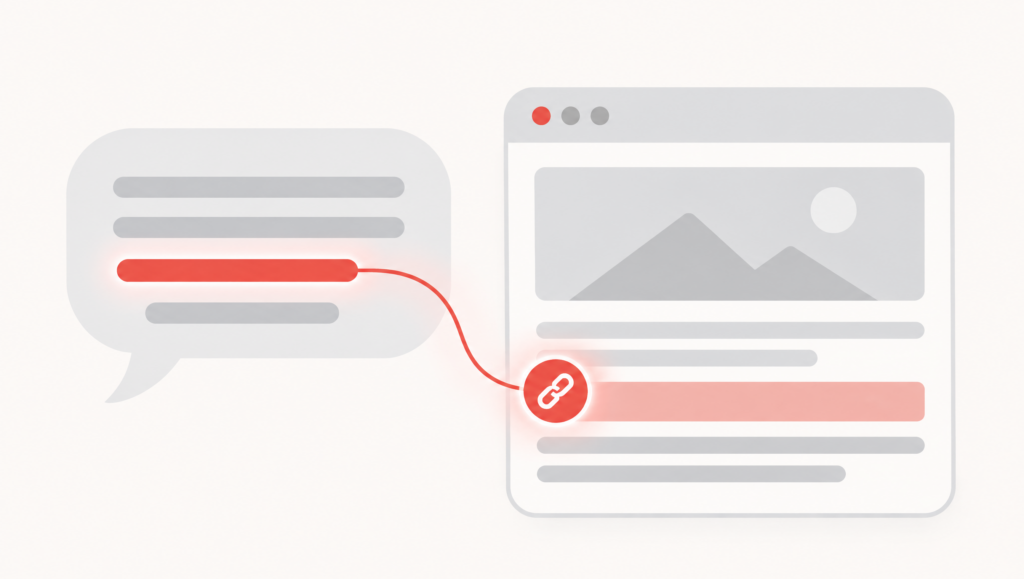
To get cited by Claude, your pages must be reachable by Anthropic’s bots, findable through Claude’s web search and clear enough to quote. Claude searches the web when a question needs current information, and it shows the sources behind each answer. For B2B companies, that makes Claude one more place where buyers meet your brand, or meet a competitor instead.
This guide explains how Claude finds and cites pages, which Anthropic bots to allow and how to check access. It also covers the page formats that tend to be quoted, how to test your visibility and what no one can promise. At the end, you get a Claude visibility checklist you can copy.
How does Claude find and cite web pages?
Short answer: Claude runs a web search when a question benefits from current information, reads several sources and writes an answer grounded in them. Anthropic says every web search response includes citations, so users can check where each claim came from. Your page has to be found, read and judged useful before it can be cited.
Anthropic’s help page on using web search in Claude describes this flow. Users see an indicator while Claude searches, and answers can include direct source links and short quotes. Claude can also read a full page when a user pastes its URL into the chat. The same page says Claude may use a user’s approximate location for localized results, so the answer in Brazil may differ from the answer in the United States.
Anthropic does not publish which index powers every search. In March 2025, developer Simon Willison reported that Anthropic had added Brave Search to its list of subprocessors, and his tests matched Claude’s citations to Brave results. Treat that as a strong signal, not as an official ranking rule. Our guide to checking your pages in Brave’s index shows how to audit that side.
Which Anthropic bots should you allow to get cited by Claude?
Short answer: Allow Claude-SearchBot and Claude-User on the pages you want cited. Claude-SearchBot indexes content to improve Claude’s search results, and Claude-User fetches a page when a person’s question needs it. ClaudeBot collects training data, so you can block it without losing search visibility.
| Bot | What it does | If you block it |
|---|---|---|
| ClaudeBot | Collects public content that may be used to train models | Future content is excluded from training datasets |
| Claude-SearchBot | Indexes content to improve Claude’s search results | Visibility and accuracy in Claude search may drop |
| Claude-User | Fetches pages when a user’s question needs them | Claude cannot read your page for that user |
These definitions come from Anthropic’s crawler help page, which also says its bots honor robots.txt and do not try to bypass CAPTCHAs. Our guide to robots.txt rules for AI bots has tested templates that block training while keeping AI search open.
How do you check that Claude can reach your pages?
Short answer: Check the robots.txt rules for the three Anthropic bots, then make sure your CDN or firewall does not block or challenge them. Finally, confirm in your server logs that real requests from Anthropic get a 200 response on the pages that matter most to buyers.
- Open robots.txt and look for ClaudeBot, Claude-SearchBot, Claude-User and the wildcard group.
- Remember that a named group ignores the wildcard rules, so repeat any path limits inside each group.
- Review your CDN bot settings. Some “block AI bots” switches treat every AI agent the same way.
- Search server logs for Claude-SearchBot and Claude-User, and look for 403, 429 or 503 errors.
- Confirm that key content shows in the raw HTML, not only after JavaScript runs.
Firewalls are the most common hidden blocker, because they can override a robots.txt file that looks perfect. Our guide to CDN and firewall settings for AI crawlers shows how to test each layer.
What kind of pages does Claude tend to cite?
Short answer: Claude tends to quote pages that answer one question directly, state facts in plain text and show who wrote them and when. Clear headings, short answer blocks and real tables make a passage easy to lift. These are observations from the field, not rules that Anthropic has published.
- Direct answers: a short paragraph right below a question heading.
- Specific facts: names, limits, prices and dates in visible text.
- Real tables: comparisons built with HTML table tags, never as images.
- Clear authorship: a named author and an update date on the page.
- Original material: data, templates or tests that other pages do not have.
Third-party sources matter as well. When a buyer asks Claude to compare vendors, the answer often cites review sites, industry media and product documentation. That is why off-site mentions belong in the same plan as on-page work.
How do you test whether you get cited by Claude today?
Short answer: Build a list of 20 to 30 real buyer questions, ask each one in Claude with web search on and record which domains it cites. Repeat the same list every month, because answers change over time, by wording and by location.
A simple log needs five columns: the question, the date, whether your brand was mentioned, which of your URLs was cited and which competitors appeared. Add “Search the web” to each prompt so Claude uses search, as Anthropic’s help page suggests. Keep the wording identical each month, or the results will not be comparable.
Referral data adds a second view. Visits from claude.ai can appear in GA4, although part of them arrive without a referrer and land in Direct. We explain the setup in our guide to finding Claude visits in GA4, and our guide on how to track your visibility in AI answers explains how to combine prompt tests with analytics.
What can no one guarantee when you try to get cited by Claude?
Short answer: No one can guarantee that Claude will cite your page. Anthropic does not publish how sources are ranked, answers vary by question, date and location, and Claude may prefer third-party sources. You can improve access, clarity and authority, then measure the trend over several months.
Be careful with anyone who sells guaranteed placement in Claude. There is no paid listing for organic citations, and no special tag forces Claude to quote a page. The checklist below covers what you can control.
Claude visibility checklist
Short answer: Check access first, then content, then authority and tracking. A page that fails the access checks will not get cited by Claude, however good the writing is. Work through the list in order and fix each failed row before you move on.
| # | Area | Check | Pass if |
|---|---|---|---|
| 1 | Access | robots.txt | Claude-SearchBot and Claude-User are allowed on key pages |
| 2 | Access | CDN and firewall | No blocks, challenges or 429 errors for Anthropic bots |
| 3 | Access | Server logs | Real Anthropic requests return 200 on key pages |
| 4 | Access | Raw HTML | Key content is visible without JavaScript |
| 5 | Content | Question headings | Headings match how buyers ask |
| 6 | Content | Short answers | Each section opens with a self-contained answer |
| 7 | Content | Facts and tables | Numbers, limits and comparisons are in visible HTML |
| 8 | Content | Author and date | Each page shows a named author and an update date |
| 9 | Authority | Third-party mentions | Your brand appears on sources Claude already cites |
| 10 | Tracking | Prompt log | 20 to 30 buyer questions are tested every month |
| 11 | Tracking | Referrals | claude.ai sessions are tracked in GA4 |
Frequently asked questions about how to get cited by Claude
Does blocking ClaudeBot stop me from getting cited by Claude?
Not according to Anthropic. ClaudeBot collects training data, while Claude-SearchBot and Claude-User support search and user requests. Blocking ClaudeBot signals that your future content should be excluded from training. To keep search visibility, leave the other two bots allowed on the pages you want cited.
Does Claude use Google to search the web?
Anthropic does not say which index powers every Claude search. Public reports since March 2025 link Claude’s web search to Brave Search, and Anthropic lists Brave as a subprocessor. Its help page also says images in results come through Bing. Strong visibility across several indexes is the safest plan.
How long does it take to get cited by Claude?
There is no fixed timeline. A page must be crawled and indexed before it can appear, and each answer depends on the exact question. Track a fixed list of buyer questions every month for at least three months before you judge the trend, and change one thing at a time.
Do I need special markup to get cited by Claude?
No special markup is documented by Anthropic. Clean HTML, question headings, short direct answers and accurate structured data help Claude and every other answer engine read your pages. Be wary of tools that sell an “AI tag” as a shortcut, because no AI vendor has published one.
Why does Claude cite a competitor instead of us?
Usually the competitor’s page answers the exact question more directly, or more third-party sources mention them. Open the cited page and compare it with yours section by section. Look at the answer, the facts, the date and the outside mentions, then fix the biggest gap first.
Next step
This week, check robots.txt and your firewall for the three Anthropic bots. Then ask Claude five real buyer questions and record which pages it cites. To see why results differ between assistants, read our Claude and ChatGPT comparison. If your product has an MCP server, learn how to list it in the Claude directory. For the same playbook on another engine, read how to earn citations in Perplexity.
Want more practical guides on how to get cited by Claude and other AI engines? Browse the latest articles on the Blippu blog.