
CAC Payback Period: The Number Your CFO Uses to Judge Marketing
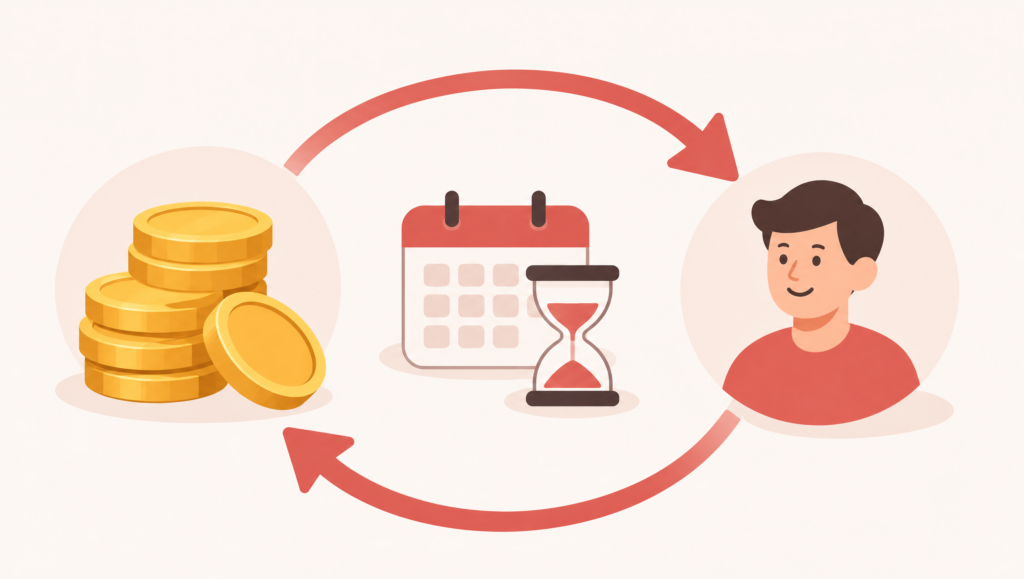
CAC payback period is the number of months it takes for the gross profit from a new customer to cover what you spent to acquire them. CFOs at software companies use it to decide whether marketing and sales spend is growing the business or burning cash. In 2026 benchmarks, the median B2B SaaS company needed 16 months to earn back its acquisition cost.
This guide explains how to calculate it and what recent benchmarks show. It also covers how to calculate payback by channel, how rising ad costs move it, which parts marketing controls and what the metric hides. It ends with a channel payback calculator.
What is the CAC payback period and how do you calculate it?
Short answer: CAC payback period equals the sales and marketing cost to acquire new customers divided by the monthly gross profit those customers bring. Gross profit is new monthly recurring revenue multiplied by your gross margin. The result is the number of months until the investment is paid back.
A worked example: you spend $120,000 on sales and marketing in a quarter and win 20 customers paying $1,000 a month each. With an 80% gross margin, they bring $16,000 of gross profit a month. The payback is $120,000 divided by $16,000, or 7.5 months.
Agree on the definition with finance before you report it. Decide which costs count (media, tools, salaries, agencies) and whether you use revenue or gross margin. Two teams using different rules will report numbers that cannot be compared.
What is a good CAC payback period in 2026?
Short answer: The 2026 Aleph and Benchmarkit report puts the median CAC payback period for B2B SaaS at 16 months, based on full-year 2025 results, down from 18 months a year earlier. Horizontal software recovered faster, at 14 months, than vertical software, at 18 months.
The figures come from the 2026 Aleph and Benchmarkit SaaS and AI Performance Benchmarks, which cover 342 software companies. Payback also varies with deal size and sales motion: enterprise deals with long sales cycles usually take longer to pay back than low-priced self-serve products.
Use the benchmark to frame the conversation, not as a target. Your own trend over the last four quarters matters more to your CFO than how you compare with the median.
How do you calculate CAC payback period by channel?
Short answer: Divide each channel’s full acquisition cost by the monthly gross profit of the customers it won. Include media, tools, agency fees and a fair share of people costs. Channel payback shows where each dollar comes back fastest, which a single company number cannot show.
- Pick a period long enough to close deals, usually two or more quarters.
- Assign each new customer to a channel, using the same attribution rule every time.
- Add up each channel’s costs, including the share of salaries and tools it uses.
- Calculate new monthly gross profit per channel.
- Divide cost by gross profit to get payback in months.
Attribution will never be perfect. What matters is using the same rule each quarter so the trend is reliable. To connect spend and closed revenue in one place, see our guide to the marketing performance dashboard.
How do rising ad costs move the CAC payback period?
Short answer: Higher click prices and new platform fees raise acquisition cost without changing what customers pay you, so payback gets longer. If paid search costs rise by a fifth and conversion stays flat, the paid search part of your CAC rises by a fifth too.
Two changes matter for 2027 plans. An October 2026 agency study found that the same B2B search clicks cost about 21% more than a year earlier. Google also raises its surcharge on ads served in France and Italy to 3% from January 2027. Neither shows up in campaign reports as a cost increase, so recalculate payback with invoice data, not dashboard data.
Which parts of payback does marketing control?
Short answer: Marketing controls the cost side and part of the revenue side: how much each qualified opportunity costs, how many of those opportunities become customers and which segments it targets. Pricing, gross margin and sales capacity sit with other teams, so agree on shared targets.
| Lever | Who owns it | Effect on payback |
|---|---|---|
| Cost per qualified opportunity | Marketing | Lower cost, shorter payback |
| Opportunity to customer rate | Marketing and sales | Higher win rate, shorter payback |
| Segment and deal size | Marketing and sales | Larger deals can shorten payback if cost does not rise as fast |
| Price and packaging | Product and finance | Higher monthly revenue, shorter payback |
| Gross margin | Finance and operations | Higher margin, shorter payback |
Lead quality matters here. A channel that produces many leads sales rejects looks cheap but pays back slowly. Our guide to MQL vs SQL explains how to agree on what counts.
What does the CAC payback period hide?
Short answer: Payback ignores what happens after the money comes back: churn, expansion and long-term value. A channel with fast payback but high churn can be worse than a slower one with loyal customers. Read payback next to retention and lifetime value, never on its own.
It also hides timing. Brand work, content and AI search visibility often influence deals months later, so they look slow in payback reports. For those, build a separate business case, as described in our guide to AEO ROI.
CAC payback period calculator by channel
Short answer: Fill in one row per channel for the same period. Add costs, new customers, average monthly revenue and gross margin, then calculate monthly gross profit and payback. Compare channels against your company target and review the table with finance every quarter.
| Channel | Total cost (A) | New customers | Avg. new MRR per customer | Gross margin | Monthly gross profit (B) | Payback in months (A / B) |
|---|---|---|---|---|---|---|
| Paid search | ||||||
| LinkedIn Ads | ||||||
| Organic and AI search | ||||||
| Events | ||||||
| Outbound | ||||||
| Total |
Formula for B: new customers multiplied by average new MRR multiplied by gross margin.
Frequently asked questions about the CAC payback period
Should CAC payback use revenue or gross margin?
Gross margin is more accurate, because it shows the money actually left to repay acquisition after the cost of serving the customer. Some companies use revenue for simplicity, which makes payback look shorter. Choose one, write it down and tell readers which one you used.
What payback do investors expect?
Expectations depend on stage, growth rate and deal size. The 2026 Aleph and Benchmarkit median of 16 months is a useful reference for private B2B SaaS. Faster-growing companies with small contracts usually pay back sooner than enterprise sellers. Ask your own investors or board what they track.
Can marketing report CAC payback without sales costs?
You can report a marketing-only version, but label it clearly. Most CFOs look at fully loaded payback, which includes sales salaries and commissions. A marketing-only number is useful for comparing channels, as long as nobody mistakes it for the company figure.
How often should we calculate CAC payback?
Quarterly is enough for most B2B companies, because deals take months to close and monthly numbers swing too much. Use a rolling period of two or more quarters for channels with long sales cycles. Recalculate whenever pricing, margin or a major cost changes.
Next step
Agree on the CAC payback formula with your finance team this week, then fill in the channel calculator for the last two quarters. Add it to your 2027 plan next to the scenarios in our guide to B2B marketing budget planning.
Want more practical guides on the CAC payback period and B2B growth metrics? Browse the latest articles on the Blippu blog.