
Agentic Buying: How to Sell When the Buyer Is an AI Agent
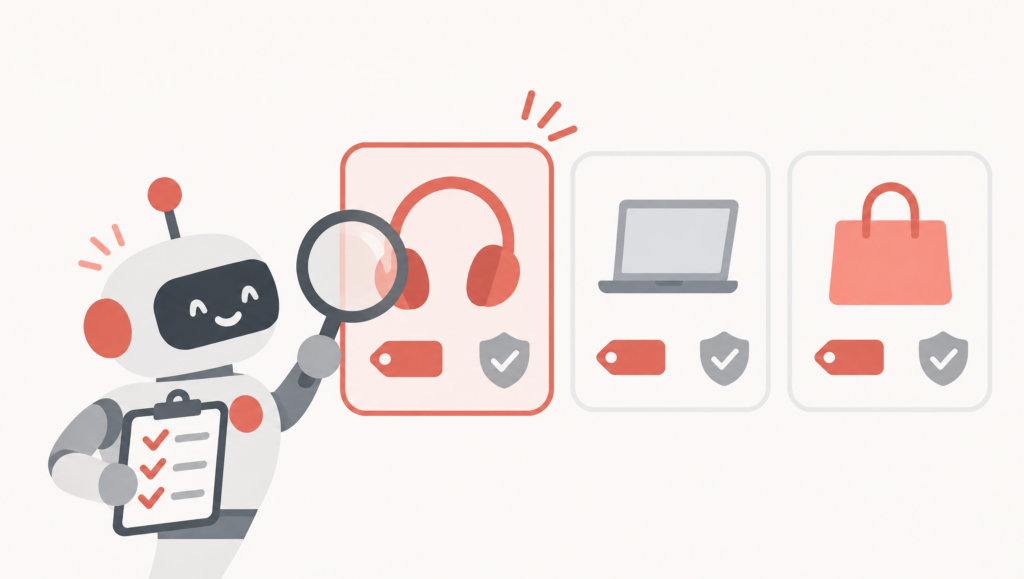
Agentic buying is the part of a B2B purchase that AI agents now handle for the buyer: finding suppliers, comparing options, drafting requests and checking the details. The buyer still decides, but an agent may read your pricing, security and product pages before any person on the buying team does. If those pages are vague, hidden or out of date, the agent moves on.
This guide explains what agentic buying is, which tasks agents already handle and what information they need from your website. It also covers how to make key pages machine-readable, why humans still validate what agents suggest and what nobody can predict yet. It ends with an agent-readiness audit you can run on your own site.
What is agentic buying, and how is it different from AI search?
Short answer: AI search answers a buyer’s question; agentic buying acts on it. In AI search, a person asks a chatbot and reads the answer. In agentic buying, an AI agent carries out tasks for the buyer, such as building a supplier list or drafting an RFP, and hands back the result for a human to approve.
The difference matters for marketing. Our guide on how AI search is changing the B2B buying journey covers people who use chatbots to research. With agentic buying, the agent reads your pages, extracts facts and compares you with others without a person reading every word. Your website becomes a data source as much as a sales page.
Which buying tasks are AI agents handling today?
Short answer: Agents handle bounded tasks: spend analysis, supplier discovery, shortlist building, RFP drafting and checking requirements. Fully autonomous purchasing remains rare and is limited to high-volume, low-risk, repeatable purchases. For complex B2B deals, agents do the research and preparation, and people make the final decision.
In October 2026, Forrester published its 2027 predictions for business buying. It predicted that agentic buying will play a role in 75% of B2B purchases, mostly through tasks like spend analysis, supplier discovery and RFP drafting. The same report said that 82% of buyers in its 2026 survey reported that their purchase included some AI functionality.
The shortlist is already shifting. G2’s March 2026 survey of 1,076 software buyers found that 51% now start their research with an AI chatbot more often than with Google.
What information do buyer agents need from your website?
Short answer: Agents need facts they can extract and compare: what the product does, who it is for, pricing or pricing logic, integrations, security certifications, data handling, contract terms and proof of results. If a fact is missing, hidden in a PDF or locked behind a form, the agent cannot use it.
| Information | Where it usually lives | Common problem |
|---|---|---|
| Product scope and use cases | Product pages | Vague claims instead of concrete capabilities |
| Pricing or pricing model | Pricing page | “Contact us” with no logic or ranges explained |
| Integrations | Integrations page or docs | Logos only, no details on what each one does |
| Security and compliance | Trust or security page | Certifications listed only inside gated PDFs |
| Data handling and privacy | Privacy policy, DPA | Legal text with no plain summary |
| Proof | Case studies, reviews | Results without numbers, dates or context |
Forrester’s first recommendation to providers is direct: keep product, pricing, security, privacy, compliance and performance details accurate, structured and easy for buyer agents to access.
How do you make pricing, security and compliance pages machine-readable?
Short answer: Put the facts in plain HTML text and real tables, use clear headings that match buyer questions and keep each page focused on one topic. Add accurate structured data where it fits, keep dates visible and remove the need to download a file to learn the basics.
- Write a one-paragraph summary at the top of each key page that states the main facts.
- Move certifications, regions and data retention rules from PDFs into visible text.
- Explain your pricing model in words, even if exact prices depend on a quote.
- Use HTML tables for plans, limits and feature comparisons.
- Add Organization and Product structured data that matches the visible text.
- Show a “last updated” date on pages that change.
None of this is new to AEO. Our guide to structured data for AEO covers the markup side, and the same pages that help AI search also serve buyer agents.
Why do humans still validate what agents recommend?
Short answer: Buyers use agents for speed, but they still check the output before they commit money. They turn to sales reps, customer references, partners and analysts to confirm what the agent found. Agentic buying shortens research; it does not remove the need for trust.
A Gartner survey released in May 2026 found that 69% of B2B buyers prefer to validate AI-generated insights with sales reps. Forrester goes further and predicts that buyers will double their human interactions to check AI recommendations in 2027.
Risk review is the other brake. G2’s July 2026 Buyer Behavior Report found that IT security review is the biggest source of delay (39%) between choosing a vendor and completing the purchase. Clear security pages help both the agent and the reviewer.
What can’t anyone predict about agentic buying yet?
Short answer: Nobody knows which agents will dominate, how they will rank suppliers or how fast autonomous purchasing will spread beyond simple, repeatable orders. Predictions from analysts are useful signals, not certainties. The safe bet is to make your facts clear, accurate and easy to find.
That bet pays off whatever happens, because the same work helps human buyers, AI search and buyer agents. Avoid anyone who sells a special “agent format” as a shortcut; no agent vendor has published one.
Agentic buying readiness audit
Short answer: Use this audit on your five most important commercial pages. Each row is a check an agent would effectively run when it reads your site. Fix every “No” before you invest in anything more advanced, then repeat the audit each quarter.
| # | Check | Pass if | Yes / No |
|---|---|---|---|
| 1 | Product summary | The first paragraph states what the product does and for whom | |
| 2 | Pricing logic | The pricing model is explained in visible text | |
| 3 | Plans and limits | Plans and limits are in an HTML table | |
| 4 | Security facts | Certifications and data regions are in visible text, not only in PDFs | |
| 5 | Integrations | Each integration has a short description | |
| 6 | Proof | Case studies include dated, specific results | |
| 7 | Freshness | Key pages show a last-updated date | |
| 8 | Access | No key facts require a form or login | |
| 9 | Structured data | Markup matches the visible text | |
| 10 | Human path | A buyer can reach an expert quickly to validate details |
Frequently asked questions about agentic buying
Is agentic buying the same as autonomous purchasing?
No. Agentic buying covers any part of the purchase that an AI agent handles, such as supplier discovery or RFP drafting. Autonomous purchasing is the narrow case where an agent completes the transaction alone. Forrester expects that to stay limited to high-volume, low-risk, repeatable purchases for now.
Do I need a separate website for AI agents?
No. Separate AI-only versions of pages create mismatches and maintenance problems. Make your existing pages clearer instead: facts in plain text, real tables, question headings and accurate structured data. The same pages then serve human buyers, AI search and buyer agents at once.
Should we publish exact prices for agentic buying?
Not necessarily. Many B2B companies price by quote. What matters is that the pricing model is explained: what drives the price, typical ranges where you can share them and what is included. An agent can work with clear logic, but it cannot work with “contact us” alone.
How does agentic buying affect sales teams?
Sales teams meet buyers later and with more information already gathered. Their role shifts toward validation: confirming facts, answering risk questions and explaining fit. Gartner found that 69% of buyers prefer to validate AI-generated insights with reps, so expert access still matters.
Next step
Run the readiness audit on your pricing and security pages this week, and fix the first three “No” answers. Because agents work for whole committees, pair this with our guide to marketing to the full buying group. For a way to present your product fairly next to competitors, read our guide to building trustworthy comparison pages.
Want more practical guides on agentic buying and AI search? Browse the latest articles on the Blippu blog.